
Playing with Third wheel POV
Reading An American Marriage by Tayari Jones

Welcome, readers! As a reminder, this is Reading Like a Writer, where I examine the craft of writing through (mostly) literary fiction I’m reading.
I first heard about An American Marriage through an interview with Tayari Jones. Something she said struck me, when asked why she did not call her book An African American Marriage. I will paraphrase, but her response was perfect. There was no need for a qualifier, just as there would not be for a “white” American marriage. It is American, full stop.
I was in.
The synopsis of An American Marriage from the author’s site:
Newlyweds Celestial and Roy are the embodiment of both the American Dream and the New South. He is a young executive and she is artist on the brink of an exciting career. They are settling into the routine of their life together, when they are ripped apart by circumstances neither could have imagined. Roy is arrested and sentenced to twelve years for a crime Celestial knows he didn’t commit.
Though fiercely independent, Celestial finds herself bereft and unmoored, taking comfort in Andre, her childhood friend, and best man at their wedding. As Roy’s time in prison passes, she is unable to hold on to the love that has been her center. After five years, Roy’s conviction is suddenly overturned, and he returns to Atlanta ready to resume their life together.
Indeed, each of these three points-of-view are included. Chapters alternate between Roy, Celestial, and Andre.

How many POVs is too many?
My first novel-in-progress is full of points-of-view. Too many, some might argue (and have). There is first-person (the sound engineers at each of the protagonist Zoey’s shows), third-person (Zoey) and our overlord the omniscient (Kore, the Queen of the underworld). Yikes! I thoroughly enjoy writing these perspectives, but will my reader enjoy reading them?
In An American Marriage, the three POVs at times felt like the relationship the characters were navigating: One too many. I began to find myself annoyed when it was Andre’s turn to speak. I didn’t want to hear from him! He was the third wheel, no matter the plot.
What is this instinct, as a reader, to close out these extra voices? In my aforementioned manuscript, one reader said he did not want to hear another character’s POV. He cared about what the protagonist felt only. Stubbornly, I want this related character’s POV included. But at what cost?
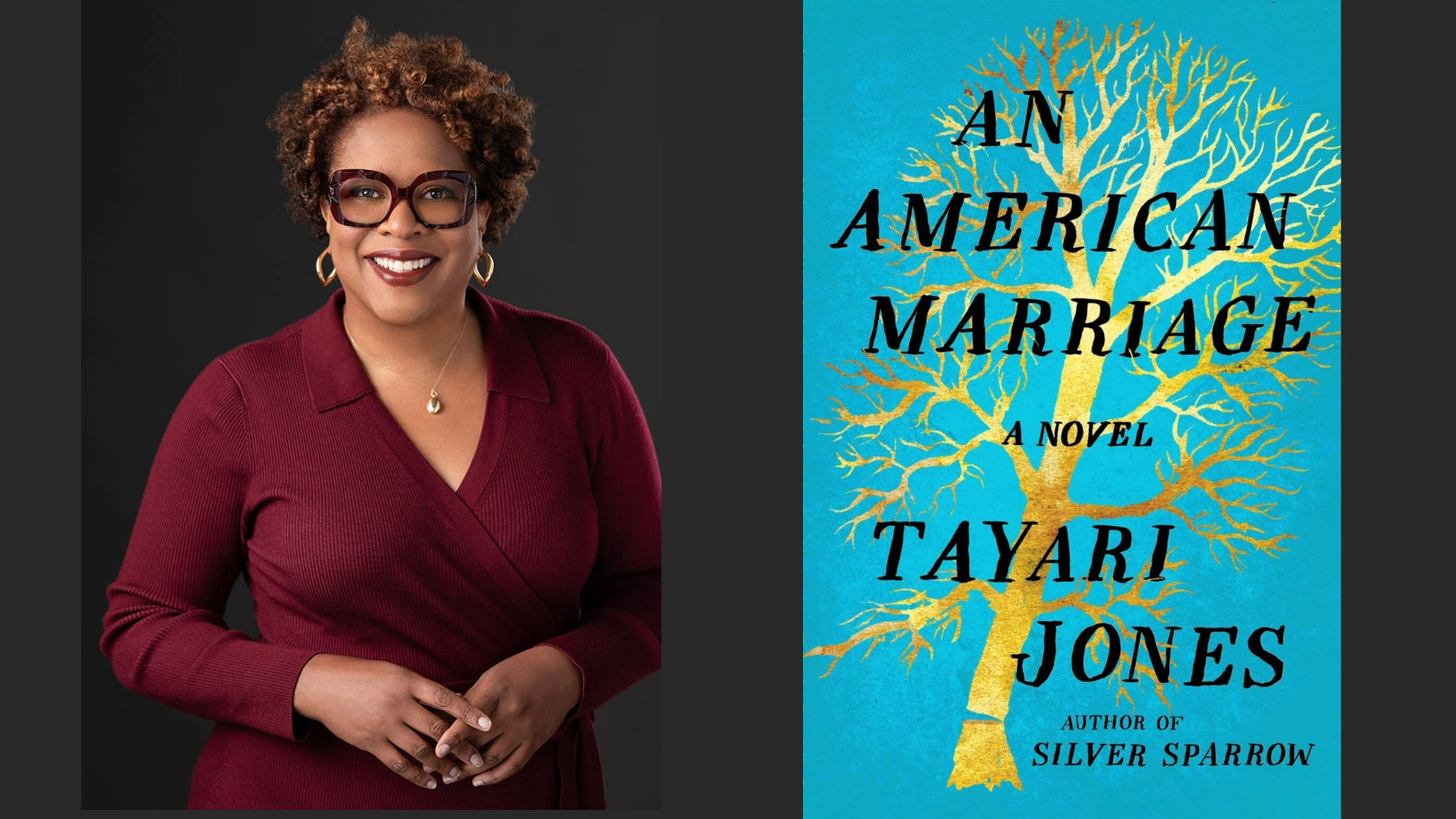
No matter the number of minds experienced, the writing still engaged this reader as outlined below.
Playfulness and voice
There is nothing like being pleasantly surprised. Jones’ work is full of voice and playfulness. Consider the following lines:
“What’s wrong,” I asked, turning down the volume of the greatest hip-hop album in history.
I love that little touch. The character’s opinion and attitude all in one.
“I was laying myself down like a coat over a mud puddle.” —Andre, regarding his offer to help Celestial
Poor fellow. So much reflected about his situation in his assessment.
“She was so proud that she could have been her own mother.”
Haha!
Carefully timed repetition with the theme of Celestial’s dolls popped up in the narrative with a similar element of play. The dolls also were described as looking like Roy, the husband; another bit of jocularity.
“Five thousand dollars for a baby doll?” Olive fanned herself with the magazine…”I guess that’s why God invented white folks.”
Chronology obfuscation
When I’m writing, I often get stuck when trying to decide how specific I need to be about time. Some of my critique partners want to know exactly what year something takes place, for instance. This is understandable and sometimes necessary.
Yet too much specificity can also weigh the story down. In this book, Jones mostly does not ground the reader in specific time. For instance, the letters to and from prison between Roy and others are undated. The reader is left to surmise how much time has passed in them from the contents (eg: “Two months has passed since…”). We understand the doubt that grows in Roy after his wife fails to mention him in an interview about her dolls in his valediction:
—Your husband (I think), Roy
A beautiful way to show a change in affections (or assuredness of affections) over implied time. There are many other indicators of time, just not dates.
The time shifts are well-executed. We the reader often learn some bit of news with the characters, which is enjoyable since it adds to the feeling of being immersed in the story. For example, Roy does not tell us about all of his prison experiences in his letters as they are happening: They are revealed subtlety much later to other characters.
Characterizations and insights
In absence of dates, there are other beautiful details that create our belief in the characters. When Roy writes to Celestial’s father—a strong and proud man—for help connecting with Celestial, his father-in-law both supports Roy and copies his daughter on a return letter. This small act in the letter (“cc: C.G. Davenport.” ) shows his class and ethical fortitude. No secrets in his house.
The story adeptly follows themes of consent versus force, particularly with Andre. This line is telling:
"When a woman shuts you out, picking the lock won’t let you back in.”
Another insightful line from Roy:
“It’s never a good sign when a woman brings up another brother out of the blue like that.”
I appreciated how Jones conveyed Roy’s suave nature when he recognizes her as his server after having met her briefly years before:
“I’ll have a Jack and coke,” he said. “Georgia girl.”
I was frustrated with Celestial throughout the story. On one hand, she was upset Roy’s mother did not believe in her love. On the other, she (at times) did little to show it. To the work’s credit, Celestial’s motivations (or lack thereof) are rendered later in the text, allowing the reader to feel empathy for what she went through to visit him in prison, and deepening her characterization.
Roy Senior stood up for his adopted son throughout the story, showing his strong character. In a great display of subtext, Roy Senior asks Roy, “Has there ever been one time when you felt like I didn’t do all I could do?” Roy’s answer: “Who told you?” I won’t spoil the hidden question.
No easy villains
Complex characters also make the reading experience more immersive. In An American Marriage, there are no clear villains or heroes. Roy is both betrayed and a betrayer. The same might be said of Celestial and Andre.
Not coddling reader
I like that Jones did not explain things that some audiences may not know, not offering an explanation for some of the references from Black culture.
I first heard this discussed—to explain or not to explain cultural or racial references the dominant group may not understand—on the Code Switch podcast. The risk of explaining is annoying a core part of the audience. The risk of not explaining is many people not understanding.
In a short story of mine to be published this month, Migrations, I struggled with this decision as well. Do I italicize the Greek words? Explain what Meltemi is? I tried to strike a balance, but have heard both “I need more explanation.” and “If you explain more I will be annoyed.” I went with the latter.
One example:
“Watching Roy Senior John Henry his wife’s grave.”
Though the name was familiar, I had to Google John Henry. Now, getting meta: Do I explain? (Perhaps you, reader, are more learned than I.)

Things that took this reader out of the story
In addition to Andre’s narrative feeling like a third wheel’s report, there were a few other things distancing me slightly from the story.
My mind had to do minor acrobatics to recognize that all the characters referred to their parents primarily by their first names. I had to keep them straight. I could understand one character calling his or her parent by a name (I have friends who do this) as a distancing choice, but all of them? Seemed unlikely.
One thing I loved about this book is it very cleverly brought to light something incredibly disturbing—disproportionately targeting and imprisoning Black people—through Roy’s very believable plight. It’s extremely difficult to write something both engaging and with a moral point weaved into it without sounding preachy. I know this from experience when trying to integrate a subject such as the ethics of eating animals into a narrative. And it was mostly very successful.
But at some points I found the narrative to over-moralize. For instance, here, Jones understandably tries to compensate for the tired stereotype of the so-called “welfare queen” perpetuated in the 1980s. (Ask me about a poem I wrote calling corporations the real welfare recipients circa ‘95. But only if you want to read an excerpt!)
When introducing herself, a single mother says: “Hyper-educated single mother here.” It just did not sound natural.
Later, there was a moment when I feel like Roy should have reacted to a particular betrayal yet he said nothing. It did not ring true with the other parts of Roy.
Though the characters are eating eggs and bacon throughout (products from immense suffering in 99% of the cases) I like that Roy’s character notes something made of ivory and observes: “This is real, isn’t it? Poor elephant.” When Celestial defensively replies that it’s old, from before they were endangered, Roy adds that this doesn’t make much difference to the elephant.
This is positive, but the part that took me out of the story is when Andre says pages later (after Roy’s saying it without Andre in earshot) he’s sorry for elephants killed for their ivory. It read like an authorial voice/insertion that did not quite fit.
The other bit I struggled with was the fact that Roy and Celestial had only been married 1.5 years before he was incarcerated, and even then it did not seem like THAT great of a marriage. It was more difficult to feel the rift wrought from prison with this as the set-up. Five years would be more believable. I do understand the marriage’s fragility was part of the setup.
Minor quibbles. I will not give any spoilers, but the ending felt satisfactory. I am so glad I read the book.